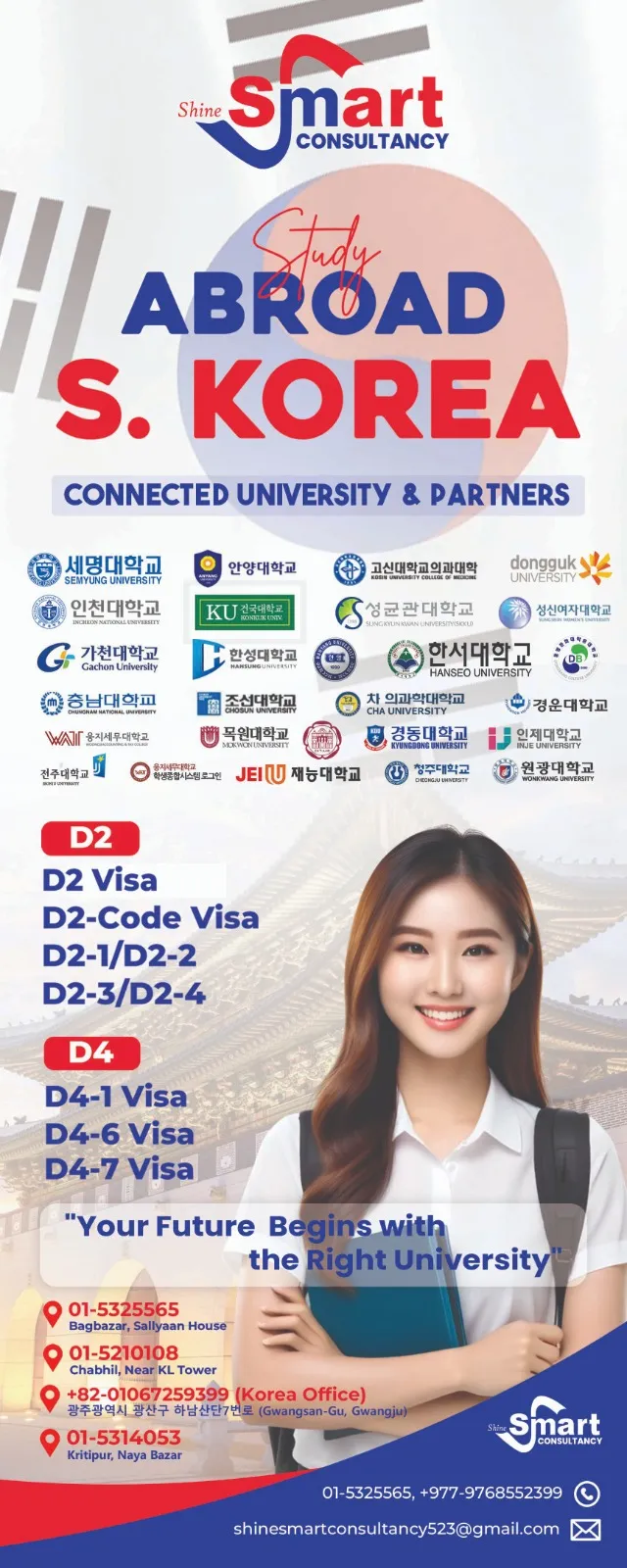
Study in South Korea
Quick Facts
Key information at a glance to help you understand the essentials.
- capital
- Seoul
- currency
- South Korean Won (KRW)
- language
- Korean (English programs increasing)
- population
- 51+ million
- timezone
- GMT+9
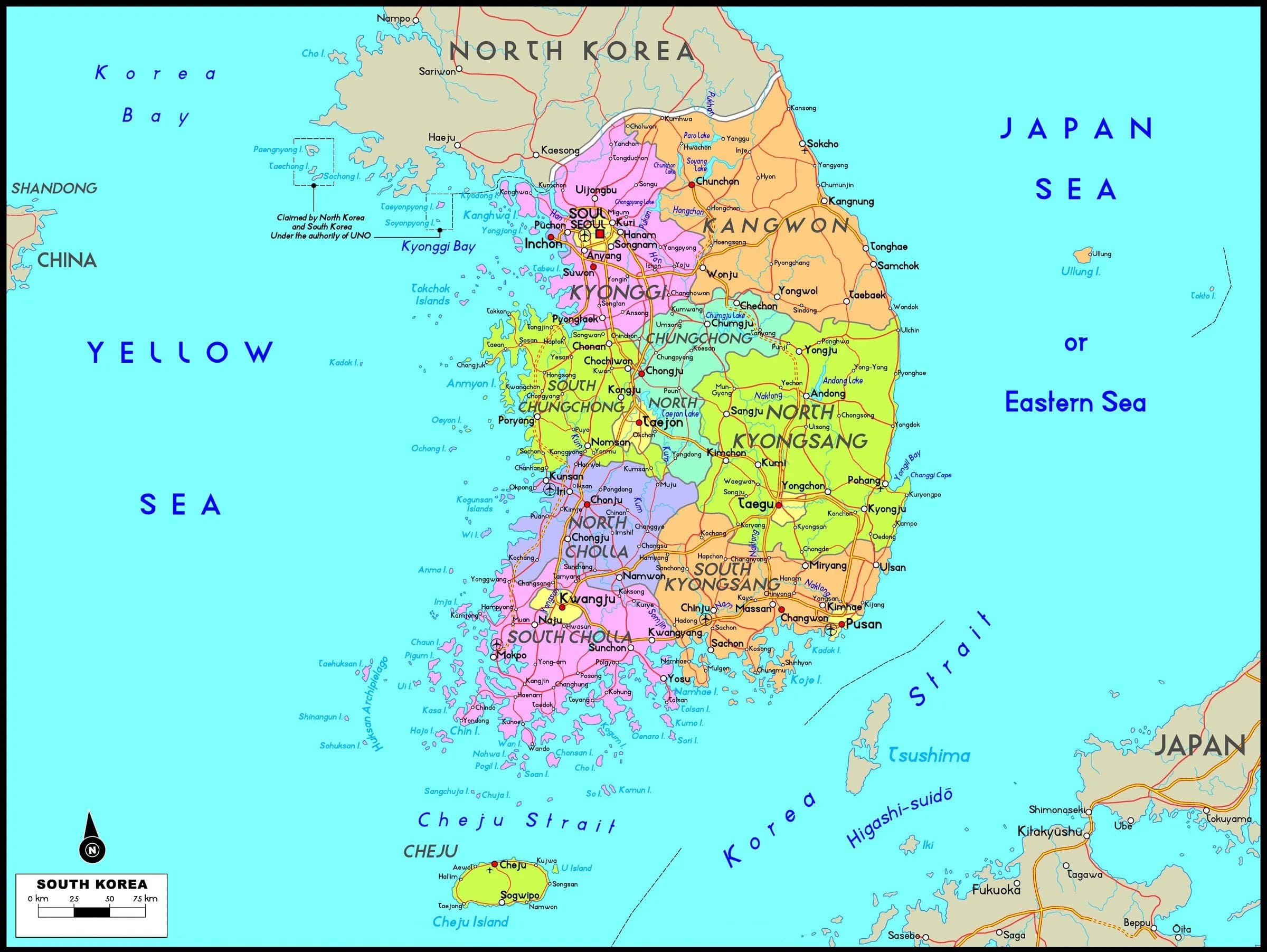
Why Nepalese students choose South Korea
Key reasons that make South Korea a preferred destination for higher education and global career opportunities.
South Korean universities, such as SNU, KAIST, and Yonsei, are consistently ranked among the world’s best, offering rigorous academic programs particularly in STEM and Business.
Compared to the US or UK, tuition fees and living expenses in Korea are remarkably affordable, with numerous government-funded scholarships like the GKS covering full costs.
Students live in the world’s most digitally connected society, providing a front-row seat to innovations in Robotics, AI, and Green Energy.
Beyond academics, students experience the global phenomenon of K-Pop, K-Drama, and world-class cuisine, making it a culturally enriching experience.
Korea is consistently ranked as one of the safest countries in the world, featuring 24-hour amenities and a highly efficient public transportation system.
The D-10 Job Seeker visa allows graduates to stay and transition into professional roles within global giants like Samsung, LG, and Hyundai.
Top Universities
Leading institutions recognized globally for academic excellence
Public Policy, Medicine, Engineering
Robotics, Artificial Intelligence, STEM
Business Administration, Social Sciences
Law, International Relations, Finance
Materials Science, Chemical Engineering
Popular Courses
High-demand academic programs commonly chosen by international students.

Best Cities for Students
Student-friendly cities known for education, lifestyle, and opportunities

Visa Process
A step-by-step overview of the student visa application process.
Once you pay your tuition, the university issues a "Standard Admission Letter" and a "Certificate of Business Registration." This is the foundation of your visa application.
You must show a bank balance (typically $10,000–$20,000) held in the student's or parent's name. For many Nepali students, this must be held for a specific duration depending on the university's "Certified" status.
You submit your documents to the South Korean Embassy. This includes your educational transcripts (verified by the Ministry of Education/MOFA), health certificate (specifically for Tuberculosis), and a valid passport.
Once the visa is approved, you enter Korea and must apply for an ARC at the local immigration office within 90 days. This card acts as your ID for all services in Korea.
Cost of Education
An overview of tuition fees and living expenses to help you plan your education budget effectively.

Tuition Fees
USD 6,000 – 15,000
Average Annual Cost
USD 10,000 – 18,000
Public universities are extremely affordable (approx. $4k/year), while private "SKY" universities (Seoul, Korea, Yonsei) are higher.
Living Expenses
Health Insurance
for Students

Mandatory
Estimated Cost
USD 600 – 900/year
Scholarships & Funding
Explore available scholarships, grants, and financial aid options for international students to support their education journey.

Global Korea Scholarship (GKS)
Amount
Full Tuition, monthly allowance (KRW 1M–1.5M), airfare, and 1-year Korean language training.
Eligibility
Non-Korean citizens; under 25 (UG) or under 40 (Grad); GPA above 80%.
GIST/KAIST Scholarships
Amount
Full Tuition waiver + monthly stipend (approx. KRW 350,000) + meal allowance.
Eligibility
International students in Science & Tech programs; must maintain a minimum GPA.
Yonsei/Korea Univ. Merit
Amount
30% to 100% Tuition waiver depending on the semester's ranking.
Eligibility
Enrolled international students with high academic performance (GPA based).
*Scholarships are competitive and based on academic merit and English scores.
Career & Post-Study Rights
Discover part-time and post-study work opportunities along with earning potential, helping students gain valuable experience and build successful international careers.
Average Salary
Part-time: KRW 9,860 – 11,000/hour (Minimum wage). Graduate Salary: KRW 35,000,000 – 50,000,000 per year (~USD 26k–38k).
Estimated annual earnings after graduation
During Study
Students with a D-2 visa can work 20–30 hours per week (depending on their Korean proficiency level/TOPIK). Those with higher TOPIK scores (Level 3+) get more hours.
Part-time work rights for students
Post Study
The D-10 Job Seeker Visa allows students to stay for 6 months, extendable up to 2 years, to find a professional "E-type" work visa.
Graduate work permit duration